Showing posts with label time. Show all posts

April 01, 2014

Musings on John Donne’s concept of time

Love, all alike, no season knows, nor clime,
Nor houres, dayes, moneths, which are the rags of time.
Yesterday marked the death of John Donne (1572-1631), English poet and the Dean of St Paul’s. I have a particular interest in him. I wrote my master’s thesis about him, specifically about his concept of time.

Donne isn’t exactly known as a philosopher of time. I chose him because he was a prolific writer and the abundant material promised me an access to his mind. I wasn’t interested in a philosopher’s formulated concept of time anyway. I wanted to know how an ordinary Elizabethan Englishman understood it. And despite not being a philosopher, Donne’s texts had plenty of references to time – even from a philosophical point of view.


I have been interested in time ever since I started studying history. The early modern concept of time became my focus later on, especially in relation to the emergence of the modern concept of time. But I wasn’t interested in change when I studied Donne; I wanted to know how time was understood at a particular time in history.

Meticulously, I posed questions that seemed relevant back then about subjective and objective time, cyclical and linear time, secular time and timeless eternity. Unsurprisingly, Donne’s thinking didn’t easily yield to my systematic approach. It was linear and cyclical at the same time, as well as secular and sacred. He had a strong sense of decline, that the world was deteriorating towards the inevitable end, which was a fairly common view in Renaissance.

I seem to have concluded in my thesis, having read it for the first time in ages, that for Donne, the concept of time was a theological issue. He mostly wrote about it in his devotional material and he expressed views similar to theological thinkers, especially St Augustine. The bulk of his texts is devotional, however, so the data is slightly biased towards that interpretation.

His emphasis on sacred meant that time was irrelevant compared to the timeless eternity that was to follow. For example, he wrote in Devotions upon Emergent Occasions (1624), when he thought he was on his deathbed, that happiness shouldn’t be bound to time:
What poore Elements are our happinesses made of, if Tyme, Tyme which wee can scarce consider to bee any thing, be an essential part of our hapines? […] if this Imaginary halfe-nothing, Tyme, be of the Essence of our Happinesses, how can they bee thought to be? Tyme is not so; not so, considered in any of the parts thereof.
But he had more irreverent ideas too, especially in his poetry where he could bend time to his liking. In Womans Constancy he tells how a woman is unable to be faithful for longer than a fleeting moment:
Now thou hast lov’d me one whole day,
To morrow when thou leav’st, what wilt thou say?
Wilt though then Antedate some new made vow?
Or say that now
We are not just those persons, which we were?
One couldn’t trust anything temporal.

The conclusions of my thesis are temporal too, bound to time. I stand by them, but they offer only a superficial understanding of Donne’s concept of time, and that of the early modern in general.

February 25, 2014

Questioning the immutability of God

Ranters was a Commonwealth era sect that wasn’t necessarily Utopian or apocalyptic as such. Some say it didn’t really exist either. I bring them up anyway, because they held some interesting beliefs that suggest the idea of change unlike any other during their time. Namely, that God wasn’t immutable.

Ranters came about around 1649. They adhered to a notion similar to that of Quakers, that Christ was present in every believer – or in all living creatures. While Quakers took this to mean that the believer existed in a sinless state when Christ was present in them, Ranters maintained that nothing could be sin while Christ was in them. This led to a behaviour that was judged amoral by their contemporaries, like cohabiting without marriage and multiple partners living in a marriage-like arrangement. Mosaic laws didn’t concern them either when they were in the state of grace.

Parliament considered Ranters to be a highly disruptive force that had to be destroyed at all costs. However, some modern historians argue that the group didn’t really exist, that they were created by the conservatives as the other to be feared. The middle view is that they were small disconnected groups without proper leaders. Whatever the true scope, they disappeared soon after the Restoration when the sects were being purged.

Even though the sect was never large or powerful, some texts are attributed to them. A Single Eye (1650) is a pamphlet by Laurence Claxton (1615-1667). In it, he questions the immutability of God. As I mentioned in an earlier post, one reason why Christians were unable to see the future different from the present was the notion that God and His word – in this case, the end of the world – were unchanging.

In the letter to the reader, Claxton states that he has seen God being worshipped in so many manners around the country that it isn’t possible He is the same for all. According to him, God “thou pretends to Worship, whether he be Infinite, or Finite; whether he be subject to passion and affection, … and whether he can be changed by thy prayers, so us to expiate a judgement, or produce a deliverance … is passionate, God is affectionate, and if either, then changeable.”

For Claxton, a god who could be one thing to one person, and completely different to another, was changeable. In a culture that believed in the immutability of God, the idea was radical. It’s also the kind of mentality that is prerequisite for the modern concept of time. I haven’t run into similar examples, however. As a unique text, it is intriguing, but doesn’t yet herald a new word view.

A Single Eye by Laurence Claxton, 1650.

December 10, 2013

The new definition of ‘old’


As I mentioned in an earlier post, the idea emerged during the renaissance that time, as well as space, could be regarded from various perspectives. And like space, time seemed different when studied from different points of view. The concept of time took first steps towards becoming relative.

As long as the concept of time was static, the point of view remained in the present. The past and the future gained value in relation to it. And as change wasn’t an attribute of time, things that were farthest from the present seemed the oldest.

This changed when other perspectives were adopted. Instead of the present, things could be studied from the past’s point of view, from past towards the present. It made the passage of time more obvious. Consequently, it became possible to understand that things had been young once and aged through time. It was understood, too, that the entire mankind had been young once and aged towards the present, a revelation in itself.

Age still equalled wisdom. But now it was understood that the present time was old as opposed to the younger times of the past. Therefore, it was the present that held the greater wisdom. Things weren’t decaying after all; they were getting better.

The most notable person to assume the new definition of ‘old’ was Sir Francis Bacon (1561-1625). He is often regarded as the herald of the new era, and his early adaptation of the new perspectives to time is one of the reasons for it:
 “These times are ancient times, when the world is ancient, & not those which we account ancient ordine retrogrado, by a computation backward from ourselues.”
For some, this has meant that Bacon was hostile towards the past, but like I mentioned in an earlier post, he put great store on the past knowledge. However, he understood the importance – and possibility – of new knowledge too:
“Antiquity deserueth that reuere[n]ce, that men should make a stand thereupon, and discouer what is the best way, but when the discouery is well taken then to make progression.”
Just like an older person knew more than a younger one, it was possible for his time to acquire greater knowledge than the earlier times had had.

The change in the perspective, and the new concept of old gave birth to the notion that it was possible to gain new knowledge instead of relying on the old. Essential for the birth of the modern concept of time, and the idea of progress.

Bacon, Francis: Of the aduancement of learning, 1605.

Source:
Bacon, Francis: The Tvvoo Bookes of Francis Bacon. Of the proficience and aduancement of Learning, diuine and humane. Printed for Henrie Tomes. London 1605.

December 03, 2013

‘Old’ and ‘age’ in the renaissance concept of time


A fascinating aspect of the renaissance concept of time is how ‘age’ and ‘old’ were understood. As I mentioned in the previous post, in the static, spatial concept of time all the aspects of time existed in the same space, the present. Similarly, past people and knowledge were understood as contemporaneous to those of the present. Change wasn’t assumed between the past and the present.

The passing of time was expressed with sequences. Some things, ideas, or people preceded others – they had come earlier – but they hadn’t gone away. Aristotle preceded Thomas of Aquinas, for example, but wasn’t replaced by him. They were contemporaneous. But they weren’t the same age.

Things didn’t age through time, like for modern people. Age was measured from the point of view of the present. Earlier things in the sequence were older, because they had existed longer, and the latter were, consequently, younger. Aristotle had been around longer and so was older than Aquinas who in turn was older than the scholars of the present.

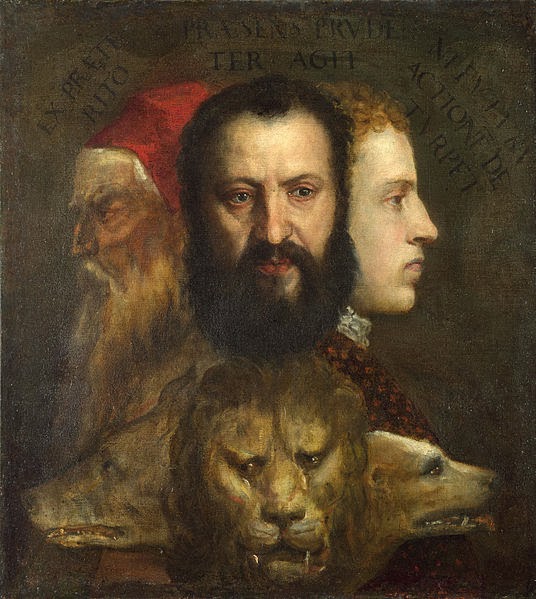
The same applied to the aspects of time, as demonstrated by the Titian painting, with which I illustrated the previous post too. From the point of view of the present – the man staring out of the painting – the past has existed longer, and so is represented by the old man. The future, in comparison, is simultaneous to the past and the present, but since it hasn’t been around that long, it is represented by the young man.


Age equalled wisdom. Therefore, people and ideas that came earlier, and so were older, were more important than the younger things closer to the present. Earlier knowledge held stronger authority when compared with the present, although a great difference wasn’t seen between older things; from the point of view of the present, the past seemed to shrink.  Aristotle and Aquinas were held to be closer to each other in the sequence than the latter to the present.

Equalling age with wisdom made possible the renaissance idea of decay as well. As present achievements would never reach the age of the past ones, it wasn’t possible to surpass the achievements and knowledge of the earlier times. The closer one came to the present, the worse it seemed in comparison to the past. When the idea was brought to its natural conclusion, it wasn’t a great leap to believe that everything would continue to deteriorate towards the end of all things.

This definition of ‘old’ was slow to change, but when it did, it heralded a change in the concept of time.

November 26, 2013

The paradox of the static concept of time


The modern concept of time assumes that time is relative. Time can be regarded from different points on the linear continuum and it seems different from each point of view. Though flexible in that respect, it’s inflexible in another. A person perceiving time can be aware of either the past or the present, but not both at the same time. We can either reminisce about things gone or plan for the future to come.

For us, the aspects of time are different and separate. The past is gone forever and the future doesn’t exist yet. Present is but a fleeting moment in between, forcing us to orient towards either past or the future.

Our way of thinking would be alien to early modern people. For them, things didn’t change through time or because of it. Change wasn’t an attribute of time. Instead, time was perceived as a space where all its aspects were present at the same time. And all of them could be observed from one point, the present, simultaneously.

Because change wasn’t assumed, it made sense for the early modern people to use the past as advice to the present. And because all aspects of time existed in the same space, it was possible for them to be aware of the past and the future at the same time – a paradox that tends to baffle the historians of renaissance thought.

Modern historians have found it difficult to understand how renaissance humanists could be interested in the past, wish for a golden age to return, and write utopias at the same time. Their solution has most often been to ignore one of these interests and regard the other as the dominant, a very unsatisfactory solution.

Sir Francis Bacon (1561-1626) is one of the scholars baffling historians. He yearned for the return of a lost golden age of knowledge, wrote a utopia, the New Atlantis, and developed a new system of learning that sealed his fame as an ‘advanced’ thinker. The latter has dominated his reputation and most historians have seen his interest in the golden age as a ‘quaint’ hobby, a remnant of an age that was already passing.

But the confusion disappears when one understands that, for Bacon, time was spatial. The past and the present weren’t mutually exclusive, they were simultaneous. For him, his system of learning was about returning the lost knowledge, not by recreating it or renewing it – updating it to his own time – but by recovering it as it had been for the benefit of his own time. This would bring about the lost golden age and elevate his age to its former glory. He is a prime example of a person who held a spatial concept of time.

New Atlantis, too, is spatial in the manner of the early utopias. It’s not about a familiar place in the future; it’s about a strange place in the present time. Time doesn’t cause the difference but distance. None of the renaissance scholars imagined a future different from the present.

The paradox of the static concept of time is, therefore, such only for modern thinkers who understand time to be relative. For someone who understood time spatially, the ability to consider the past and the present at the same time was self-evident and didn’t give cause to commentary. The renaissance scholars, too, become more understandable when one remembers that they viewed the world – and time – spatially, not temporally.

Titian: Allegory of Time Governed by Prudence c. 1565.

Past is the old man, future the young, and both are 

simultaneous with the middle-aged man who

represents the present.

November 19, 2013

From spatial perspective to temporal?


That time is relative – how it feels depends on the point of view of the observer – may be self-evident to us. It is, however, a fairly new idea and one that marks the change from medieval worldview, where the present was the only observation point, to modern. But it’s curiously poorly understood how such a tremendous change took place. Many theories have been proposed, but none of them seems entirely satisfactory to me.

One fascinating explanation is given by Wolfgang von Leyden in his article History and the Concept of Relative Time (1963). He suggests that changes in the concept of time happened simultaneously with – or as a consequence of – changes in how space was understood. Perspective, the visual representation of the idea that objects seem different depending on where one observes them from, was introduced in painting at the end of the 15th century. Until then, hierarchy had dominated the composition. According to von Leyden, this spatial perspective led to a temporal one. People began to understand that time, too, could be observed from different points of view.

In the spatial concept of time, the difference between past and present is measured by distance, not by change. Change between two observation points isn’t perceived mostly because it isn’t expected. Change happened so slowly in medieval culture that things seemed to stay the same, and in oral culture, stories evolved to suit the present so that differences disappeared. Moreover, change was seen as evil so it was resisted. When differences were noticed, they were explained as coming from a different place, not different time.

Past and present occupied the same space. Past was distant, but essentially the same than the present. Therefore, the past could be used as advice to the present and a guide to the future, a practice that endured until the late 17th century. But it wasn’t until at the end of the 18th century that the first temporal utopia, where the difference is caused by time instead of distance, was written. This would indicate that the spatial concept of time was very resilient.

I think that von Leyden’s idea is plausible. Spatial and temporal relativity both require similar adjustment of perception. It gives rise to quite a number of questions though. Did the relative concept of time first emerge in Italy where the spatial perspective was introduced? How did it spread, independently or along other theoretical innovations? For example, van Eyck couldn’t produce proper perspective in his paintings because he didn’t understand the mathematics behind it. Was a similar theoretical understanding necessary for  the understanding temporal perspective? Did the ideas of spatial and temporal perspectives spread separately once conceived? Or was temporal perspective conceived in an entirely different setting where perhaps other contributing factors were in place too?

These are all fascinating questions. As it is, von Leyden’s idea alone isn’t enough to explain the change, but it’s worth keeping in mind.
Pietro Perugino: Delivery of the Keys to Saint Peter, 
Sistine Chapel (1481–82).

Source:
von Leyden, Wolfgang: History and the Concept of Relative Time. History and Theory, Vol. 2, No. 3. (1963), 263-285.