Showing posts with label age. Show all posts

December 10, 2013

The new definition of ‘old’


As I mentioned in an earlier post, the idea emerged during the renaissance that time, as well as space, could be regarded from various perspectives. And like space, time seemed different when studied from different points of view. The concept of time took first steps towards becoming relative.

As long as the concept of time was static, the point of view remained in the present. The past and the future gained value in relation to it. And as change wasn’t an attribute of time, things that were farthest from the present seemed the oldest.

This changed when other perspectives were adopted. Instead of the present, things could be studied from the past’s point of view, from past towards the present. It made the passage of time more obvious. Consequently, it became possible to understand that things had been young once and aged through time. It was understood, too, that the entire mankind had been young once and aged towards the present, a revelation in itself.

Age still equalled wisdom. But now it was understood that the present time was old as opposed to the younger times of the past. Therefore, it was the present that held the greater wisdom. Things weren’t decaying after all; they were getting better.

The most notable person to assume the new definition of ‘old’ was Sir Francis Bacon (1561-1625). He is often regarded as the herald of the new era, and his early adaptation of the new perspectives to time is one of the reasons for it:
 “These times are ancient times, when the world is ancient, & not those which we account ancient ordine retrogrado, by a computation backward from ourselues.”
For some, this has meant that Bacon was hostile towards the past, but like I mentioned in an earlier post, he put great store on the past knowledge. However, he understood the importance – and possibility – of new knowledge too:
“Antiquity deserueth that reuere[n]ce, that men should make a stand thereupon, and discouer what is the best way, but when the discouery is well taken then to make progression.”
Just like an older person knew more than a younger one, it was possible for his time to acquire greater knowledge than the earlier times had had.

The change in the perspective, and the new concept of old gave birth to the notion that it was possible to gain new knowledge instead of relying on the old. Essential for the birth of the modern concept of time, and the idea of progress.

Bacon, Francis: Of the aduancement of learning, 1605.

Source:
Bacon, Francis: The Tvvoo Bookes of Francis Bacon. Of the proficience and aduancement of Learning, diuine and humane. Printed for Henrie Tomes. London 1605.

December 03, 2013

‘Old’ and ‘age’ in the renaissance concept of time


A fascinating aspect of the renaissance concept of time is how ‘age’ and ‘old’ were understood. As I mentioned in the previous post, in the static, spatial concept of time all the aspects of time existed in the same space, the present. Similarly, past people and knowledge were understood as contemporaneous to those of the present. Change wasn’t assumed between the past and the present.

The passing of time was expressed with sequences. Some things, ideas, or people preceded others – they had come earlier – but they hadn’t gone away. Aristotle preceded Thomas of Aquinas, for example, but wasn’t replaced by him. They were contemporaneous. But they weren’t the same age.

Things didn’t age through time, like for modern people. Age was measured from the point of view of the present. Earlier things in the sequence were older, because they had existed longer, and the latter were, consequently, younger. Aristotle had been around longer and so was older than Aquinas who in turn was older than the scholars of the present.

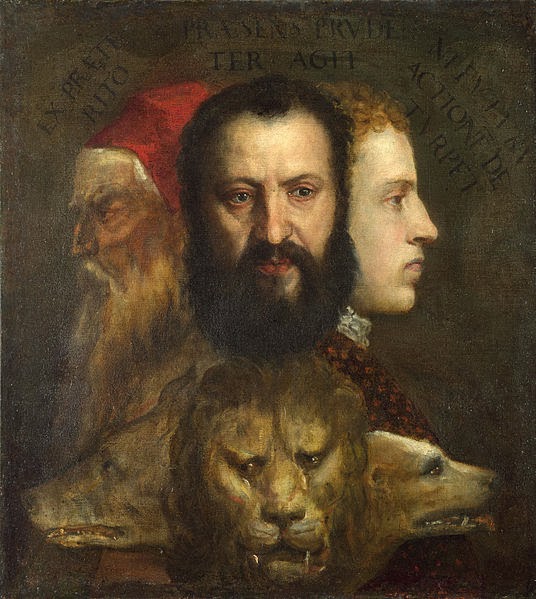
The same applied to the aspects of time, as demonstrated by the Titian painting, with which I illustrated the previous post too. From the point of view of the present – the man staring out of the painting – the past has existed longer, and so is represented by the old man. The future, in comparison, is simultaneous to the past and the present, but since it hasn’t been around that long, it is represented by the young man.


Age equalled wisdom. Therefore, people and ideas that came earlier, and so were older, were more important than the younger things closer to the present. Earlier knowledge held stronger authority when compared with the present, although a great difference wasn’t seen between older things; from the point of view of the present, the past seemed to shrink.  Aristotle and Aquinas were held to be closer to each other in the sequence than the latter to the present.

Equalling age with wisdom made possible the renaissance idea of decay as well. As present achievements would never reach the age of the past ones, it wasn’t possible to surpass the achievements and knowledge of the earlier times. The closer one came to the present, the worse it seemed in comparison to the past. When the idea was brought to its natural conclusion, it wasn’t a great leap to believe that everything would continue to deteriorate towards the end of all things.

This definition of ‘old’ was slow to change, but when it did, it heralded a change in the concept of time.